
Today ANZ announced that it will no longer provide direct project finance to pipelines dedicated to new oil and gas fields. The new policy brings ANZ into line with CommBank, NAB and Westpac, which all have restrictions on finance for pipelines built for new oil and gas extraction projects.
This is a major blow to Beetaloo Basin fracking companies, whose dream of turning the ultra-remote region into the world’s next major gas fracking frontier depends on the construction of thousands of kilometres of new pipelines.
Australia’s biggest gas pipeline company, APA Group, plans to build multiple pipelines connecting Beetaloo to LNG export terminals in Queensland and the Northern Territory. But, turning these plans into reality will require billions of dollars in financing from banks.
ANZ’s decision follows sustained campaigning this year by Market Forces, ANZ customers, shareholders and Rising Tide, Australia’s largest grassroots climate network.
With all four of Australia’s biggest banks now ruling out direct finance for APA Group’s Beetaloo pipelines, the fracking development’s already shaky business case just became even more far-fetched.
A victory driven by people power
Throughout 2026, Market Forces and thousands of ANZ’s customers and shareholders contacted the bank calling on it to close a glaring loophole in its fossil fuel financing policies that left the door open to directly funding APA Group’s Beetaloo pipelines.
Meanwhile, Australia’s largest grassroots climate network, Rising Tide mounted a sustained national campaign on ANZ, with activists taking action at ANZ offices and branches across Australia, disrupting business as usual and demanding the bank rule out funding Beetaloo pipelines.
On 21 October, Market Forces was joined by hundreds of demonstrators including, Rising Tide, ANZ customers, shareholders and many representatives from Australia’s climate and environment movement who gathered outside ANZ’s Melbourne headquarters, calling on CEO Nuno Matos and the bank’s board to act.
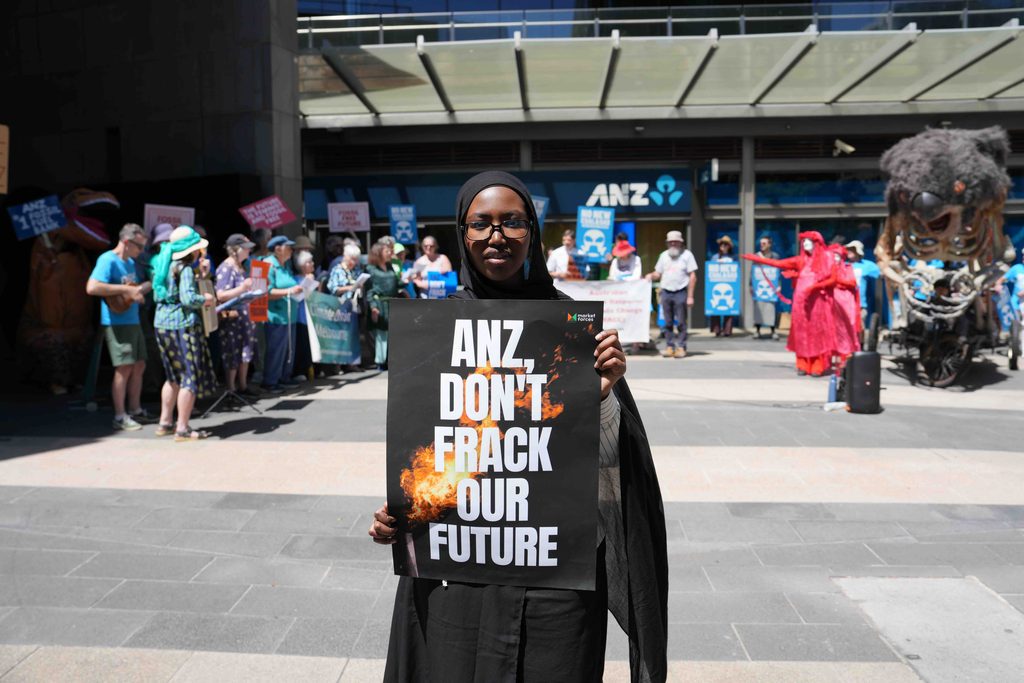
It is a reminder that when people organise, draw attention to the facts and demand climate justice, even Australia’s biggest financial institutions can change course.
Multi-billion-dollar Beetaloo pipedream is becoming even harder to finance
APA Group’s proposed North to East Australia pipeline (NEAP) would stretch approximately 1,561 kilometres from the Beetaloo Basin in the Northern Territory to Queensland’s existing gas pipeline network, enabling the transport of vast quantities of fracked gas to LNG export markets.
Without enormous new pipelines, the gas industry’s ambitions to transform Beetaloo into one of the world’s largest gas fracking developments cannot become a reality.
But APA’s pipeline plans have an enormous problem: the economics are looking increasingly disastrous.
Recent Market Forces analysis has found NEAP could cost as much as $9.74 billion, significantly more than APA’s earlier indicative figures implied.
APA is already carrying more than $14 billion in debt, building this enormous pipeline would require billions in additional investment and debt finance, carrying a plethora of risks to the company, communities, consumers and the climate.
The combined cost of production and transportation means the delivered gas is likely to be expensive and would need sustained high prices to recover the cost of the infrastructure required to get it to market, potentially locking consumers including Australian households and businesses into even higher energy costs while also worsening the climate crisis.
Even some of the world’s biggest oil and gas companies don’t see Beetaloo as being viable. Recently, senior Chevron and ExxonMobil executives both said they are not convinced Australian shale gas from Beetaloo could ever be financially viable, pointing directly to the cost of extraction and remoteness of the development.
ExxonMobil’s vice-president Neil Chapman specifically called out the costs of transporting gas from Australia’s interior to export markets, and questioned whether it could ever compete globally.
Rising costs and financing risks are derailing new gas power and import projects in the targeted growth markets of Asia, while renewable energy surges. The future demand profile for LNG in Emerging Asia is shaky, as countries grapple with soaring costs and LNG’s failure to deliver on promises of reliability and affordability, they are increasingly looking to renewables for their energy future and security.
Market Forces analysis estimates Beetaloo gas supplied through NEAP could be one of the costliest new sources of gas exports in the world. With all of these factors at play, the business case is losing ground fast.
Now Australia’s four largest banks have delivered their own verdict through their financing policies – this is not a pipeline they are prepared to back.
A warning to every bank considering backing APA Group
ANZ’s decision should send a huge signal to the international banking sector.
NEAP would be an extraordinarily expensive and risky piece of fossil fuel infrastructure, built to enable major new gas extraction at a time when the world needs to rapidly reduce emissions and transition away from fossil fuels.
The banks best placed to understand APA Group’s financial position, Australia’s energy markets, and the considerable risks of this project, have all established policy barriers to directly financing Beetaloo’s pipelines.
The message is clear, if Australia’s biggest banks have ruled out project finance for NEAP, international banks shouldn’t go anywhere near it.
But the work is far from finished.
Australia’s major banks continue to provide general purpose corporate financing and other financial services to APA Group, while ANZ and Westpac maintain relationships with major Beetaloo proponents Santos and INPEX. Macquarie continues to provide critical financial support to leading Beetaloo fracking companies Beetaloo Energy and Tamboran Resources.
Project finance exclusions are a powerful signal, but alone are not enough. Banks must ensure their corporate lending, bond arrangements and other financial services do not provide a backdoor for funding the very fossil fuel expansion their policies are intended to prevent.
For APA Group and the companies dreaming of turning the Beetaloo Basin into an enormous new gas export province, the financial obstacles are mounting.
Together, we can Stop Beetaloo. Don’t Frack the Outback.