
Project profile
Stop Beetaloo –
Don’t Frack the Outback
Australia is on the precipice of an enormous new high-risk fracking venture in the heart of Australia’s Outback, the Beetaloo Basin.
The Beetaloo Basin risks becoming the biggest gas development in Australia’s history, and could be one of the largest fracked gas basins in the world* – unless it is stopped.
For Beetaloo to move from gas industry fantasy to climate-wrecking reality, gas companies need billions of dollars in funding.
That means the banks can make or break Beetaloo!
Beetaloo could become the biggest climate disaster in Australia – but by turning off the money tap we can stop it.
Call on the banks to Stop Beetaloo – Don’t Frack the Outback.
Sign the Petition
Together, we can make Beetaloo unbankable!
We’ll use this petition to show the banks that community opposition to Beetaloo fracking is growing and cannot be ignored.
Petition statement:
To all banks, in Australia and around the world:
We urge your institution to rule out providing any new or renewed financing to companies involved in fracking in the Beetaloo Basin in Australia’s Northern Territory.
Your name will be added to the petition in the form [first name] [first initial of last name] (e.g. John S.).
The Beetaloo Basin
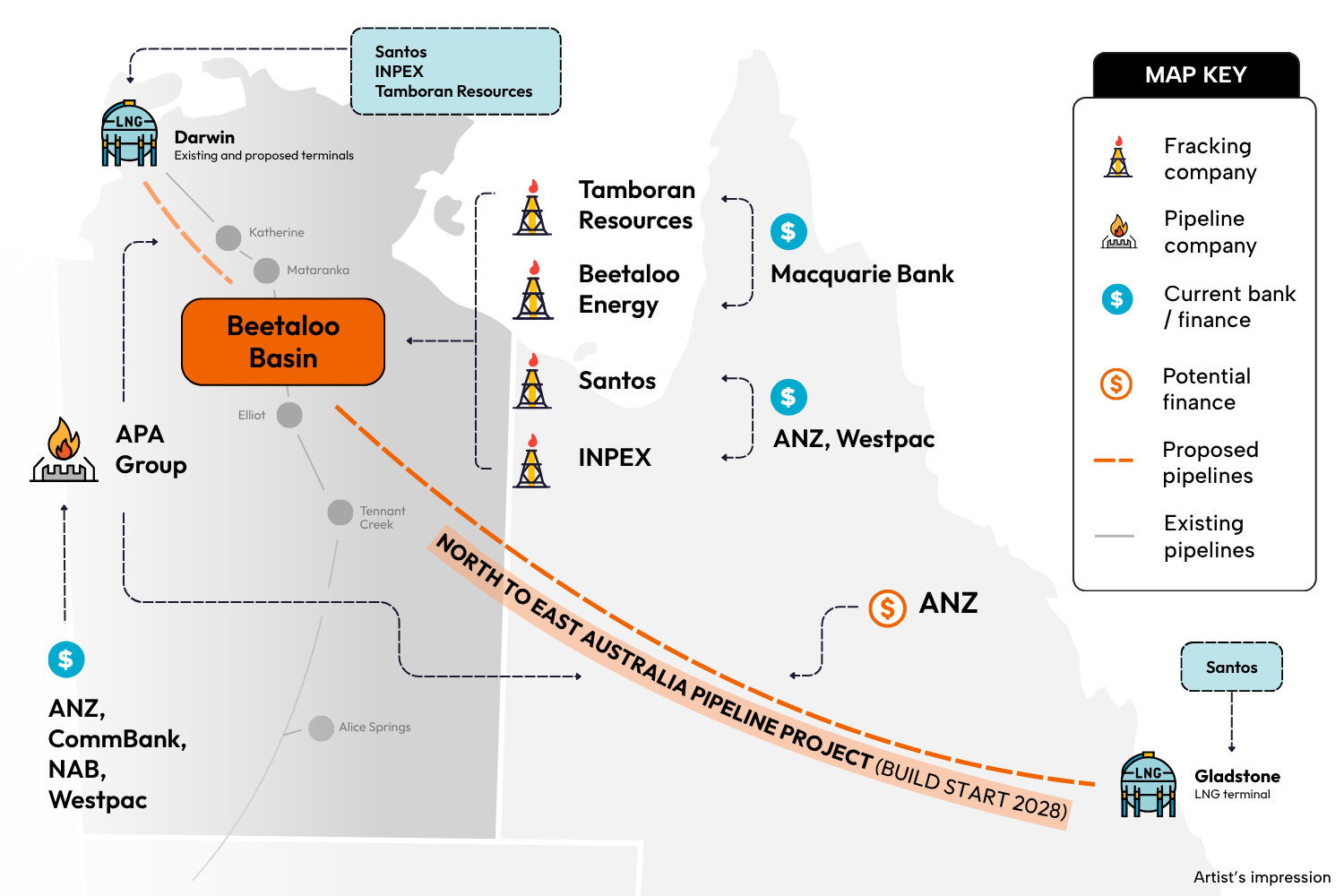
Meet the companies behind Australia’s biggest fracking push
The Frackers
Beetaloo Energy Australia | Tamboran Resources | Santos
The Pipeline company
APA Group
Australia’s Beetaloo Banks
Macquarie | ANZ | Westpac | CommBank | NAB
Beetaloo is a climate bomb Australia and the world cannot afford to detonate
In the heart of the Australian Outback, fracking companies are recklessly racing to drill what they regard as one of the world’s next major shale gas reserves, the Beetaloo Basin.
But in reality, Beetaloo is Australia’s Pandora’s box: a disastrous fossil fuel development that we cannot afford to be unleashed.
Beetaloo is not compatible with a safe climate
Beetaloo is marketed by the fracking companies as one of the world’s largest and most significant shale gas reserves, containing 200 to “500 trillion cubic feet (TCF) of discovered and prospective gas resources.”*
While these figures are prospective and total recoverable gas volumes are still unknown, should Beetaloo hold this much gas and it be extracted and burned – Beetaloo would become one of the world’s largest fracked shale gas basins and one of the largest gas fields ever developed.
The potential carbon footprint of Beetaloo is enormous – at the gas companies’ most aspirational scale (500 TCF), the combustion of Beetaloo gas would produce 26.25 billion tonnes of CO₂-e. That would be the equivalent of running Australia’s biggest coal fired power station, Eraring, until the year 3971.
Even if Beetaloo only reaches one-tenth of that scale, it would still emit over 2.6 billion tonnes of CO₂-e: like running Eraring for another ~194 years.
A fossil fuel development of this size is outrageous. Starting large scale extraction and combustion in the 2030’s would be actively choosing a path of catastrophic climate breakdown.
The world’s leading climate and energy bodies have been clear for years: earth is on track for hazardous levels of warming unless we rapidly cut fossil fuel use as soon as possible – we cannot afford to extract and burn more.
“we are currently heading towards outcomes in the range of 2.5-3 °C, with severe implications for lives and livelihoods around the world.” – Dr Fatih Birol, Executive Director International Energy Agency, World Energy Outlook 2025
The Intergovernmental Panel on Climate Change (IPCC) has concluded that emissions from existing and committed fossil fuel infrastructure (as at 2018) will significantly overshoot the 1.5°C warming limit. The goal of 1.5°C requires global emissions to have almost halved by 2030.
The International Energy Agency (IEA) has stated that to achieve net zero by 2050, no coal mine expansions or new oil and gas fields can go ahead.
As a new (greenfield) gas basin, Beetaloo is scientifically incompatible with limiting global warming to 1.5°C in line with the Paris Agreement.
Every new gas pipeline, processing facility or LNG export terminal developed as a result of Beetaloo fracking locks Australia and the world deeper into long-term fossil fuel use and increases the probability of catastrophic climate change.
Beetaloo would cost Australians more
Despite the gas industry propaganda, Beetaloo is not an energy or cost of living solution for Australians – it’s the exact opposite.
The gas companies’ have publicly acknowledged that the real goal is to frack the Outback for LNG exports – a plan that risks locking Australians into more expensive gas, higher energy costs and greater vulnerability to global price shocks.
“Beetaloo Basin – the next major shale to LNG export province” – Beetaloo Energy
“There’s no question that Beetaloo is principally going to be an LNG export play.” – Adam Watson, CEO APA Group
Ignoring for one moment the fact that oil and gas companies prioritising LNG exports has led to East Coast gas prices almost quadrupling over the past decade – even if Beetaloo was purely a domestic supply play, the gas is so remote that it makes no economic sense for Australian consumers.
Beetaloo is also forecast to be one of the most expensive sources of new gas supply for the East Coast, largely due to the substantial costs transporting gas from the centre of the Outback to Australia’s East Coast.
Beetaloo is so remote, even the world’s gas majors don’t see value in it.
Chevron CEO Michael Wirth and ExxonMobil Vice President Neil Chapman – executives from companies that have seriously considered Australian fracking opportunities – have both said they don’t see Beetaloo as financially viable.
As ExxonMobil’s Neil Chapman put it, “It’s quite a ways inland. You’ve got to build a lot of pipe to get it to the open market.” Once gas from Beetaloo reaches its destination, it will be very expensive.
Australia’s largest gas infrastructure company, APA Group is developing plans for an ultra-remote 1,561 kilometers North to East Australia Pipeline (NEAP) which leading energy consultancy Rystad Energy estimates could cost up to $4.9 billion.
The NEAP would rival the longest gas pipelines in Australia and would be an enormously expensive undertaking for APA Group, a company already carrying over $13 billion of debt.
For APA to build the NEAP, the company would need to take on billions of dollars in new debt with substantial interest costs. To then recover these costs and make a profit, APA would have to impose significant pipeline tariffs – effectively passing the cost on to customers.
“For Beetaloo gas to supply the east coast gas market, delivered gas pricing would need to remain sufficiently high to cover both production costs and the significant tariffs associated with long-distance transport.” – INPEX
This means for NEAP to be commercially viable it would need to transport large volumes of gas for decades. That would lock Australia into prolonged use of expensive gas, drive up emissions, and divert investment and support away from cheaper renewables.
Beetaloo puts water, health and Country at risk
Fracking is a high-risk gas extraction method which involves injecting water, sand and hazardous chemicals deep underground to break up pockets of gas and allow it to seep to the surface. Fracking is notorious for contaminating water systems and agricultural land, and has devastated local communities and ecosystems in the United States.
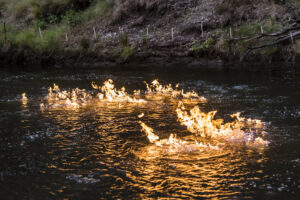
Fracking poses such severe environmental and health risks that the practice has led to bans in at least 15 countries globally, as well as in Victoria, Tasmania and most of Western Australia.
The risks in Beetaloo are already raising alarm. UN Special Rapporteur Marcos Orellana has criticised Beetaloo-related gas plans over climate, human rights and environmental concerns.
Beetaloo has faced years of opposition from local communities and Traditional Owners whose country has been severely impacted by the fracking operations including failure to report cultural artefacts and failure to adequately consult with Traditional Owners.
In a 2025 Guardian exclusive, ‘How an obscure consultancy firm is helping fracking companies influence traditional owners’, leaked documents claim that a consultancy firm hired by Beetaloo Energy promised Traditional Owners private deals, gathered signatures and hired land council members to smooth the way for Beetaloo’s gas sales. The article details extremely serious allegations that may be subject to further investigations.
Traditional Owner William John is quoted saying “They said anything I want they would do: paying me money; getting me [a] vehicle to go visit my land, fuel, money, whatever… They talked about the gas, getting the money out of the gas… I’d like someone to help stop what they’re doing.”
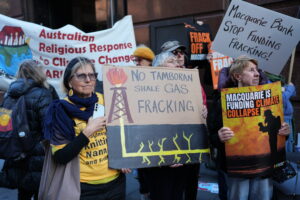
As well as community opposition there are also serious fears surrounding the impacts to the environment, water and cultural heritage, including “major risks” to groundwater, drinking water, precious aquifers and sacred sites.
Fracking Beetaloo would put water, health, Country and communities at great risk.
Beetaloo: State of Play
Beetaloo is still in the early stages of development, but the race to make it a full-scale fracking basin is moving fast.
Beetaloo is not one project or one company. It is a complex web of frackers, pipeline builders, LNG exporters and financiers working to open a giant new fossil fuel frontier in the heart of Australia.
Here is the current state of play:
Beetaloo Energy and Tamboran Resources – backed by Macquarie
Beetaloo’s leading fracking companies, drilling and driving Beetaloo toward full-scale gas production.
Macquarie is providing critical financial support to both.
Learn more
The Beetaloo Basin’s leading developers, Beetaloo Energy (formally Empire Energy) and Tamboran Resources, are currently progressing through exploration and pilot production phases, anticipating initial gas sales to the Northern Territory market as early as August 2026.
Beetaloo Energy and Tamboran Resources are non-diversified fracking companies with no current revenue and no operations outside the Beetaloo Basin. Their sole business strategy is full-scale Beetaloo development.
Until they begin selling Beetaloo gas in significant volumes, both companies remain reliant on debt and equity funding to keep progressing their projects.
Macquarie is backing both companies, and “their support has been critical.” – Alex Underwood, Beetaloo Energy CEO
Macquarie is not a passive financier. It is playing a central role in propping up the companies driving Beetaloo fracking:
- As of May 2026, Macquarie is the largest shareholder of Beetaloo Energy and has been financing the company for more than 15 years.
- In April 2026, Macquarie added $15 million to an earlier $65 million financing package the bank arranged for Beetaloo Energy’s pilot fracking project.
- In September 2025, Macquarie loaned $90 million to Tamboran Resources as part of a $180 million deal to develop its Shenandoah South pilot gas fracking project in the Beetaloo.
- In December 2024, Macquarie provided a $35 million loan to Tamboran Resources to “support [Tamborans’s] ongoing development activities,” all of which are focused on exploiting Beetaloo gas. Macquarie also owns shares in Tamboran as of a December 2025 filing.
APA Group – backed by ANZ, Westpac, CommBank and NAB†
APA Group’s proposed pipelines are what take Beetaloo from a small, remote and short-lived venture into one of the world’s largest fracking developments.
†While all big four Australian banks continue to prop up APA Group with corporate finance and bonds – ANZ is the only ‘big four bank’ able to directly fund APA’s Beetaloo pipelines.
Learn more
Pipeline developer APA Group is planning to construct thousands of kilometers of pipelines to unleash extensive Beetaloo fracking.
In December 2025, APA Group announced the proposal for the North to East Australia Pipeline (NEAP) – a massive new transmission pipeline dedicated solely to Beetaloo gas extraction.
At 1,561 kilometers the NEAP would be among the largest gas pipelines in Australia and serve as critical enabling infrastructure for large-scale fracking in the Beetaloo, connecting the gas basin to LNG export terminals in Queensland.
APA is still in the early stages of planning the NEAP, but is aiming to begin construction as early as 2028.
But APA Group, like the fracking companies, is heavily reliant on the banks.
APA Group is already carrying more than $13 billion of debt, and would need the banks to issue billions more to be able to finance the construction of NEAP, estimated to cost around $4.9 billion.
ANZ is the only ‘big four bank’ able to directly fund APA’s Beetaloo pipelines.
Santos and INPEX – backed by ANZ and Westpac
While Beetaloo Energy and Tamboran Resources are leading the fracking charge, oil and gas giants Santos and INPEX are planning a big push into Beetaloo.
ANZ and Westpac continue to bank both companies.
Learn more
Australia’s second biggest gas company, Santos, has recently taken a final investment decision on its Beetaloo drilling appraisal program and plans to commence drilling in Q3 2026.
Santos has made Beetaloo fracking its next major priority and indicated that Beetaloo gas could help justify the expansion of its LNG export infrastructure, raising the prospect of extending Santos’ export operations for decades.
INPEX is Japan’s largest oil and gas company. In March 2026, INPEX announced the company had entered into a farm-in agreement along with Daly Waters Energy* for tens of thousands of acres in the Beetaloo Basin. Prior to this time, INPEX had no stake in Beetaloo.
INPEX’s intention is to use fracked Beetaloo gas to supply its Ichthys LNG export terminal in Darwin, and may even result in the company deciding to significantly expand its LNG processing and export capacity.
*Daly Waters Energy is a wholly owned subsidiary of Formentera Partners – a Texas-based private equity firm. Based on the information available to Market Forces, there is no current connection between Daly Waters and Australia’s major banks.
Take Action – Tell ANZ and Westpac to stop funding destructive fossil fuel expansion!
Further notes and calculations
*Beetaloo reserve estimates:
Gas industry sources have described the Beetaloo Basin as “enormous” – “Australia’s largest undeveloped gas resource” (Empire/Beetaloo Energy), boasting “vast gas resources” (APA Group) in “one of the most promising shale gas basins globally” (Hannam & Partners Equity Research | Tamboran Resources).
Beetaloo is marketed by the fracking companies as one of the world’s largest and most significant shale gas reserves, containing 200 to “500 trillion cubic feet (TCF) of discovered and prospective gas resources.”
While these figures are prospective and total proved recoverable gas volumes are still unknown, should Beetaloo hold this amount of gas and be exploited by these companies, Beetaloo could be one of the biggest fracked shale gas basins in the world.
Two of the world’s largest producing shale gas basins as a comparison are the Marcellus Shale field in the United States estimated to contain 500 TCF and the Neuquén Basin in Argentina which holds 308 TCF of technically recoverable shale gas and is in early stages of development.
Emissions calculations:
The Eraring Power Station, owned by Origin Energy, is Australia’s largest coal-fired power station. It produced 13.5MtCO2-e in the 2025 financial year.
Emissions for Beetaloo at maximum scale were calculated using the following methodology:
Gas: 500 trillion cubic feet
Emissions factor: Australian National Greenhouse Accounts Factors 2025 – Natural gas distributed in a pipeline Scope 1 Emission factor (51.53kgCO2-e/GJ)
Conversion: BP’s conversion factors – 1tcf – 1019 PJ, 500 trillion cubic feet converts to 509,500 PJ
Result: 26.25GtCO2-e
26.25GtCO2-e would be the equivalent of running Eraring for an additional ~1,945 years, or the year 3971.
Australian National Greenhouse Accounts Factors are updated annually and emissions factors are specific to the Australian context. The emissions only account for Scope 1 emissions which occur at the point of combustion (consumption) and don’t factor in other emissions that occur during the production and transportation process.
Join us
Subscribe for email updates: be part of the movement taking action to protect our climate.