
Project profile
Browse LNG: Betting billions risking our reef
Image credit: Nush Freedman / Conservation Council of WA
Browse LNG: MIMI’s multi-billion dollar mistake
Japan’s Mitsubishi Corporation and Mitsui & Co. are doubling down on a bet against the world’s energy and stable climate future through their joint venture, Japan Australia LNG (MIMI).
MIMI is a proponent of the proposed Browse liquefied natural gas (LNG) project in Australia, alongside other major oil and gas giants and mega polluters BP, PetroChina, and Woodside.
- The location of the Browse LNG project directly threatens the Scott Reef: a marine biodiversity crown jewel of Australia, home to endangered green turtles and pygmy blue whales. Any industrial accidents, such as oil spills, would gravely harm these irreplaceable coral reefs and their inhabitants.
- Both Mitsubishi and Mitsui have outlined a vision of achieving net-zero emissions for their businesses by 2050. But if the carbon-intensive Browse project goes ahead as planned, it will release 887 million tonnes of carbon emissions (Mt CO2-e) over several decades.
- Browse LNG is neither internationally nor domestically cost-competitive enough to be a solid investment. Not to mention the expensive and unreliable carbon capture & storage (CCS) plans the proponents are gambling on to ‘reduce’ Browse’s emissions.
Instead of investing in a safe energy future with renewable energy, MIMI is sinking huge amounts of capital into Browse LNG, a project with the odds stacked against it, both financially and environmentally. MIMI is delaying the energy transition and the stable climate future we all want.
Mitsubishi and Mitsui (MIMI), it’s time to exit Browse.
Take Action
Send a message to Mitsubishi and Mitsui: tell them it’s time to exit Browse!
What is Browse LNG?
The $35 billion-plus Browse LNG project involves offshore gas extraction hundreds of kilometres off the coast of Western Australia. Browse Basin’s enormous Brecknock, Calliance, and Torosa gas fields are Australia’s largest untapped conventional gas reservoirs, buried under coral reefs. To make the project work, more than 50 wells need to be drilled around the pristine Scott Reef.
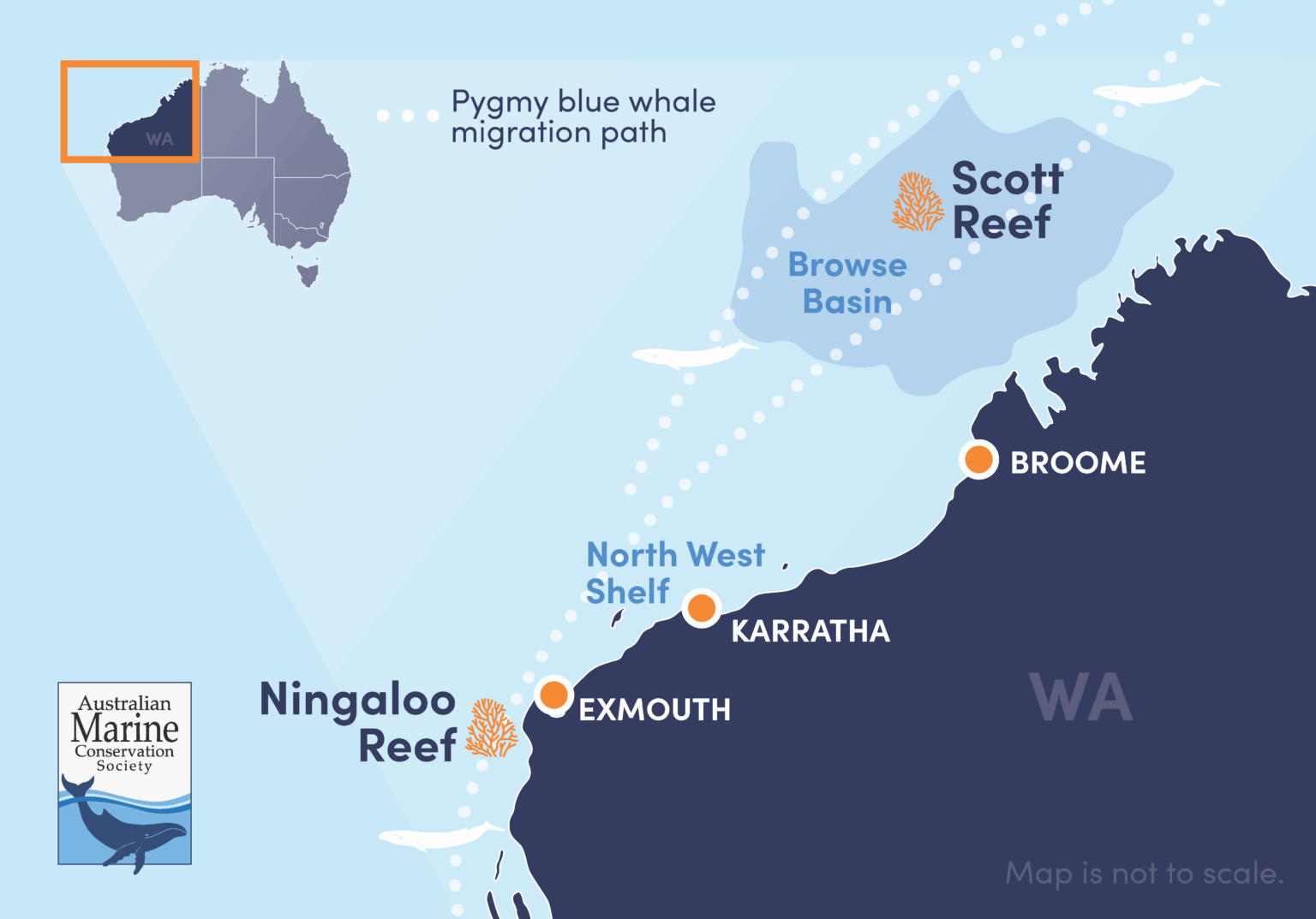
Map showing the Browse Basin and Scott Reef. Image credit: Australian Marine Conservation Society.
Browse LNG is jointly owned by mega-polluters: Australian oil and gas giant Woodside (30.6%), BP (44.3%), PetroChina (10.7%), and Japan’s Mitsubishi and Mitsui (MIMI) (14.4%). The project operator is Woodside.
MIMI, Woodside, and other gas companies want to start a project that puts marine ecosystems at major environmental risk instead of leaving the gas underground. The Browse gas will be processed in two floating production, storage, and offloading units (FPSOs) before it is transported to an onshore facility through a 900-kilometre-long pipeline laid along the ocean floor.
Most of the Browse LNG project’s gas will be processed for export to international markets at Woodside-operated North West Shelf (NWS) LNG processing plant in Karratha, Western Australia.
In 2025, the Browse LNG-related project NWS received approvals to extend operations to 2070. Despite this, Shell, one of the NWS’s owners, signalled a desire to sell its stake.
Despite some of the Browse fields being discovered nearly 50 years ago, the project has failed to materialise amid strong public opposition from conservationists and climate advocates.
What is Browse’s impact on the environment?
A carbon bomb
The Browse gas fields are extremely carbon-intensive, with an average concentration of about 10% carbon dioxide (CO2), 100 times higher than the Scarborough field (0.1% CO2).
The emissions from burning Browse gas are estimated at 887 Mt CO₂-e, equivalent to running Australia’s largest coal-fired power station for more than 65 years straight. While plans are in place for carbon capture and storage (CCS), the reliability and affordability of this technology have long been questioned. Analysis by Accela shows that at best, the CCS will only cover a small proportion of the Browse project’s total emissions.
Destruction of fragile reef ecosystems
The Scott Reef is home to incredible marine biodiversity, supporting thousands of species. This ancient reef system, comprising two large reefs formed over the past 15 million years, is at grave risk if the Browse LNG project goes ahead.

Scott Reef is home to thousands of corals, fish, sharks, rays, as well as the endangered green turtles and pygmy blue whales. Image credit: Nush Freedman / Conservation Council of WA
According to the Australian Marine Conservation Society, the Browse LNG project directly threatens the Scott Reef from:
- Seismic blasting
- Underwater industrial noise
- Chemical pollution
- Light pollution
- Habitat disturbance
- Risk of oil spills
- Risk of sinking seabed.
The pollution impacts and the risk of accidents would not only damage the local marine ecosystem, but also could extend to the beautiful, scenic Kimberley in Australia and the Indonesian islands north of Scott Reef.
In addition, Browse will add millions of tonnes of greenhouse gas emissions to the atmosphere, further fuelling the climate crisis and triggering more marine heatwaves that harm reefs.
The Browse project emissions and potential risk to Scott Reef are counter to the spirit of Mitsubishi and Mitsui’s 2050 Net Zero goals.
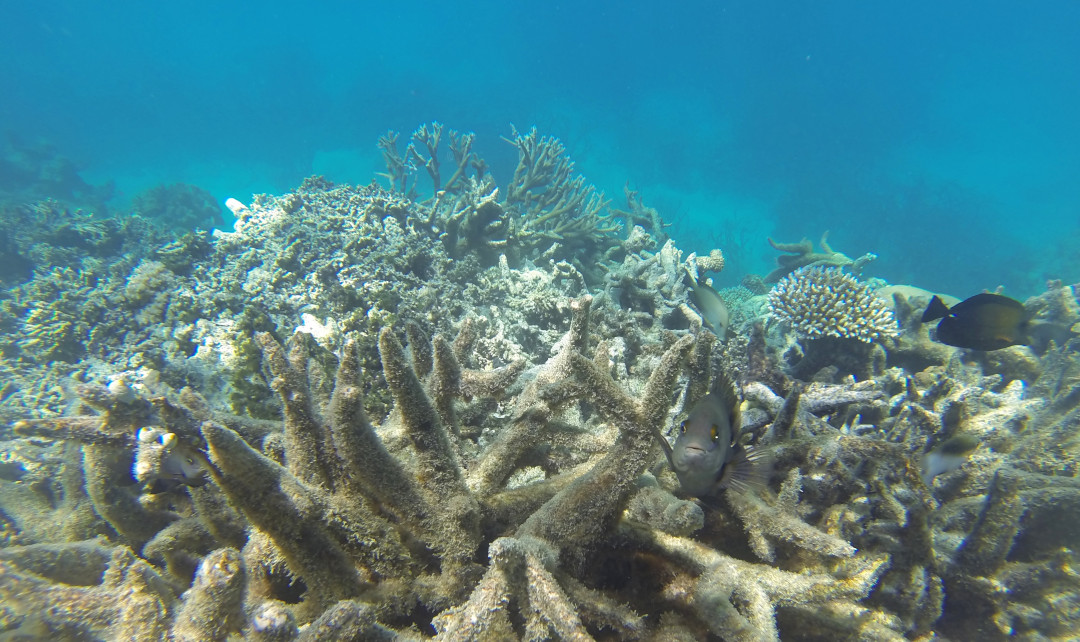
Coral bleaching after a marine heatwave.
How do local communities feel about Browse?
There has been a long history of public opposition to Browse, with over 11,000 submissions made to the WA EPA for the previous version of the Browse project. There are ongoing concerns about environmental, social, and Aboriginal Heritage issues.
Most of the Browse LNG project’s gas will be processed for export to international markets at North West Shelf (NWS) LNG processing plant, located next to the Murujuga National Park.
Murujuga is home to the largest and most diverse collections of rock art in the world. Murujuga has more than one million petroglyphs, some up to 50,000 years old, with deep significance for Aboriginal Australians.
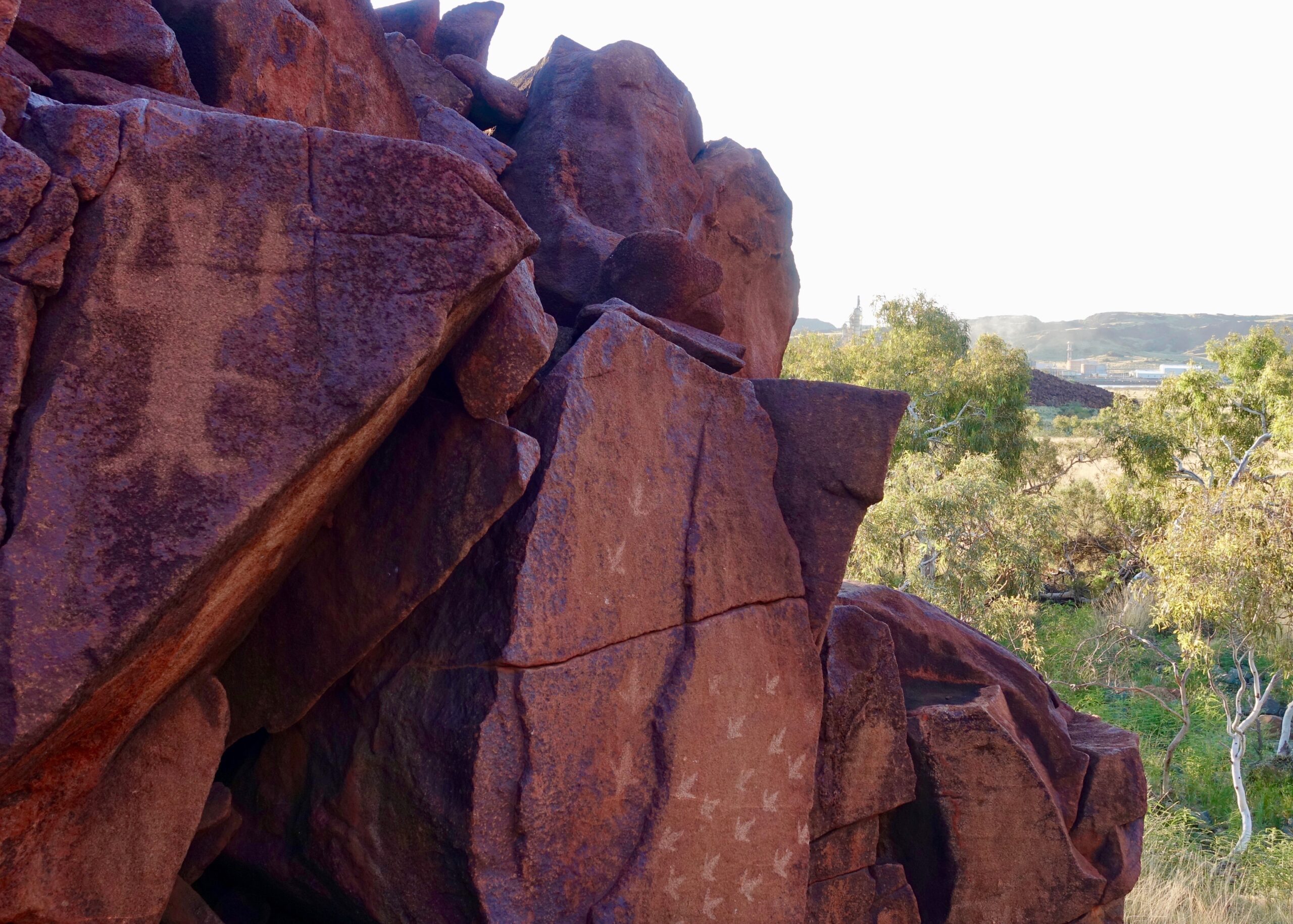
Ancient rock art in Murujuga National Park, with an ammonia plant operating nearby. Murujuga National Park, Burrup Peninsula, Pilbara WA. Image credit: Marius Fenger / Wikimedia commons
Emissions from industrial facilities near Murujuga, including NWS, are impacting the incredible rock art. Visible damage can already be seen from nearby industrial operations. Aboriginal Elders, scientists, and advocacy groups have vowed to protect the rock art that holds incredible history and cultural heritage.
Indonesian fisherfolk have been visiting the Scott Reef for hundreds of years. These fisherfolk may lose a source of their livelihoods if the reef is damaged and fish stocks are reduced.
Is Browse financially viable?
Browse LNG is neither internationally nor domestically cost-competitive enough to be a solid investment. Both Mitsubishi and Mitsui have already taken major financial hits for Browse LNG – each took impairment of JPY 40 billion in FY15.
Whilst historical cost estimates for the project were AU$30 billion, recent analysis from the Institute for Energy Economics & Financial Analysis (IEEFA) puts this figure closer to AU$37 billion on the low end and as high as $48 billion when accounting for cost overruns. In May 2026, Woodside revised the project cost to AU$48.7 billion (US$35.2 billion)
Which banks could fund Browse?
Table: List of banks that have provided finance to Browse LNG joint venture partners from January 2020 to June 2026.
| wdt_ID | wdt_created_by | wdt_created_at | wdt_last_edited_by | wdt_last_edited_at | Banks | Country | BP | Mitsubishi | Mitsui | Woodside |
|---|---|---|---|---|---|---|---|---|---|---|
| 1 | Abu Dhabi Commercial Bank | United Arab Emirates | ✓ | ✓ | ||||||
| 2 | Academy Securities | United States | ✓ | |||||||
| 3 | Agricultural Bank of China | China | ✓ | |||||||
| 4 | ANZ | Australia | ✓ | ✓ | ||||||
| 5 | Ashikaga Bank Ltd | Japan | ✓ | |||||||
| 6 | Baiduri Bank | Brunei | ✓ | |||||||
| 7 | Bancroft Capital | United States | ✓ | |||||||
| 8 | Bank of America | United States | ✓ | ✓ | ✓ | ✓ | ||||
| 9 | Bank of China | China | ✓ | |||||||
| 10 | Bank of Communications | China | ✓ | |||||||
| Banks | Country |
Source: Bloomberg and LSEG Workspace. Finance constitutes lending and/or bond underwriting data for BP, Mitsui, Mitsubishi, and Woodside (parent companies only) between January 2020 and June 2026. Data gathered and synthesised by Market Forces.
While some of these institutions have existing oil and gas policies that restrict or prohibit dedicated project financing for new greenfield oil and gas projects, it is unclear whether these exclusionary policies will extend to the corporate financing of Browse LNG joint venture partners.
The overwhelming majority of global fossil fuel finance (consistently close to 95%) takes the form of corporate financing, with only around 5% being dedicated to project finance. Any bank policy that excludes project finance but allows for corporate financing of the companies pursuing fossil fuel expansion projects is a massive loophole, enabling business-as-usual financing to continue.
Why are Mitsubishi and Mitsui (Japanese companies) involved?
The NWS project has long-term customers from Japan, which buys 40% of Western Australia’s LNG exports. The companies purchasing LNG from the NWS are JERA, Tokyo Gas, and Osaka Gas, to name a few.
Since 2018, domestic Western Australia gas prices have doubled. The gas export industry has a long history of paying minimal royalties. Australian beer drinkers pay more tax than gas companies.
By participating in the development of Browse, Mitsubishi and Mitsui are doubling down on the risky and volatile LNG market, both at home in Japan and abroad, where Japanese companies are on-selling the LNG to third countries.
What can we do about Browse LNG?
Join Us! Call on Mitsubishi and Mitsui to withdraw from Browse, a project that will harm the climate and community.
Mitsubishi and Mitsui: Exporting LNG from Browse is risky and complex. Choose Renewables instead for a safe energy future!
FAQ
1. What is LNG?
Liquefied natural gas (LNG) is predominantly methane, cooled to about -162 °C, thereby reducing its volume by 600 times and enabling transport across oceans in specialised tankers to places that do not have pipelines. It is then turned back into gas at the destination before it is used for industrial, commercial, residential, and transportation purposes.
2. Is new LNG necessary?
The International Energy Agency (IEA) has stated that new LNG terminals are incompatible with a 1.5 °C-aligned world. New upstream oil and gas projects require long lead times – 15 years, according to the Global Energy Monitor. Current and under-construction LNG capacity is expected to cause a supply glut. Recent LNG price volatility driven by geopolitical shocks makes it clear that renewable energy and battery storage offer more permanent solutions for energy independence.
3. Isn’t LNG a better alternative to coal?
Serious questions have been raised regarding the dirtiness of LNG, with academic research of US LNG finding that exported gas emits 33% more greenhouse gas emissions than coal.
Since LNG is mostly methane, it is a potent greenhouse gas with a global warming potential of over 80 times higher than CO2 over a 20-year period.
“Natural gas and shale gas are all bad for the climate. Liquefied natural gas (LNG) is worse,” said Robert Howarth, author of a groundbreaking study that challenged the narrative that gas is cleaner than coal. His peer-reviewed and published research shows that the emissions of methane and carbon dioxide from LNG’s extraction, processing, transportation and storage account for approximately half of its total greenhouse gas footprint.
4. Will Browse LNG provide jobs?
The broader oil and gas industry is notoriously reliant on expensive equipment rather than human labour, and is a relatively small employer (less than 10,000) in Western Australia, with less than 0.6% of the workforce (1.64 million) employed in the sector.
Disclaimer
The information provided by Market Forces does not constitute financial advice. The information is presented in order to inform people motivated by environmental concerns and take actions based on those concerns. Market Forces is organising data for environmental ends.
The information and actions provided by Market Forces do not account for any individual’s personal objectives, financial situation or needs. It should not be used, relied upon, or treated as a substitute for specific professional advice.
Market Forces recommends all users obtain their own independent professional advice before making any decision relating to their particular requirements or circumstances.
Join us
Subscribe for email updates: be part of the movement taking action to protect our climate.