
Report
Singaporean banks said no to new coal. Loopholes say otherwise.
How DBS, OCBC, and UOB coal policies leave room for industrial coal power
Intro
Major Singaporean banks publicly positioned themselves as moving away from new coal, but their policies continue to leave room for financing companies developing industrial ‘captive’ coal power. Between 2020 and 2025, DBS, OCBC, and UOB participated in major financing transactions involving several coal-dependent industrial groups as Indonesia expanded its nickel and aluminium industries alongside new captive coal power.
Coal policy loopholes that still leave room for captive coal risk locking part of this new industrial demand into high-emissions power and worsening climate change.
What is captive coal and why does it matter for bank coal policies?
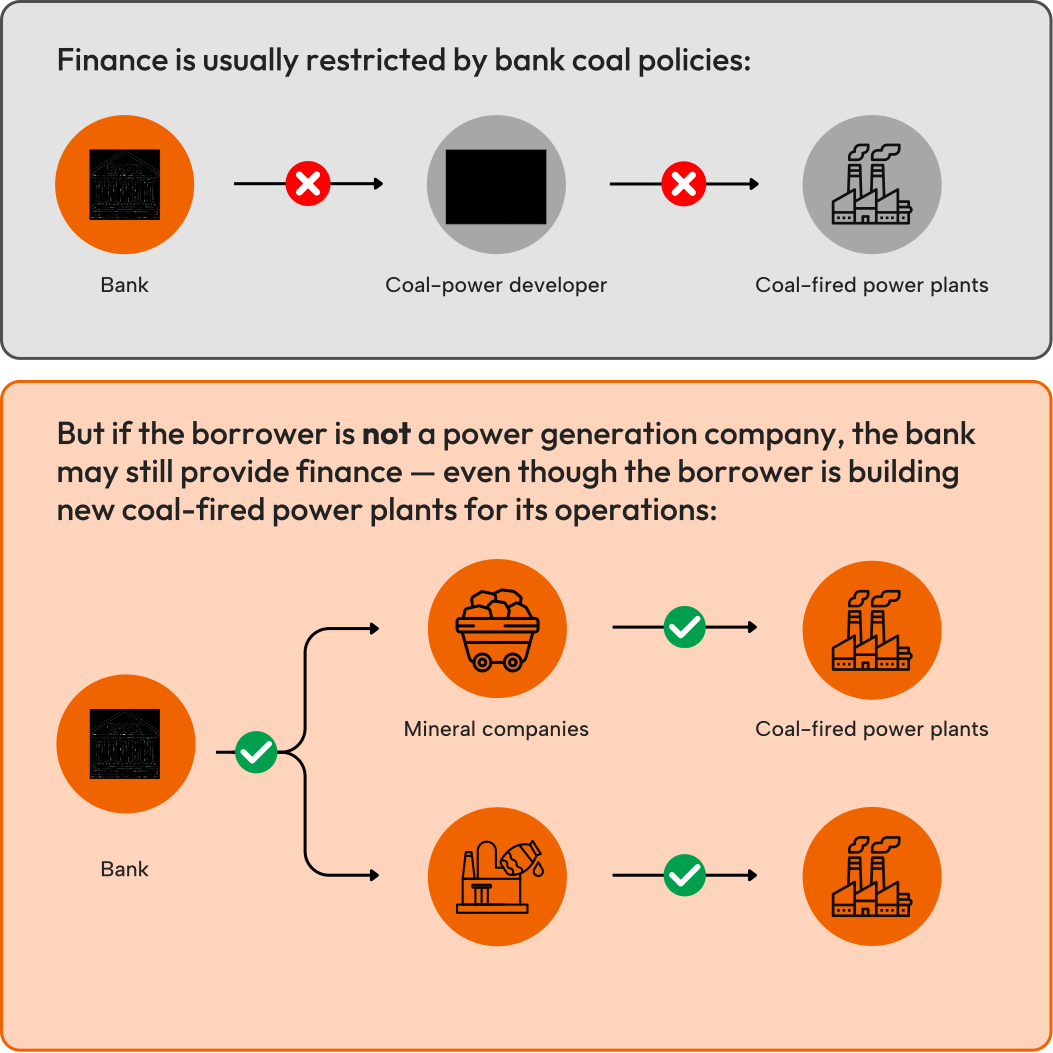
Captive coal power plants are coal power plants built primarily to supply a specific industrial facility or industrial park rather than the public electricity grid. In Indonesia, these plants have become closely associated with energy-intensive industrial expansion, including nickel and aluminium processing.
This distinction matters for bank coal policies. A conventional coal power developer is clearly part of the power-generation sector. A nickel, aluminium, or diversified industrial company can operate its own coal plant while remaining classified primarily as an industrial company.
Take action
Tell Singaporean banks they must stop financing industrial captive coal.
Spotlight on the Singaporean banks’ policy loopholes
Banks have increasingly recognised the reputational and financial risks associated with financing coal. In 2019, Singapore’s three major banks, DBS, OCBC, and UOB began announcing restrictions on new coal power plant financing, creating a clear public expectation that new coal power would no longer receive their support.
Over time, banks’ policies have developed in different ways. In each case, the policy still leaves room for financing companies that operate captive coal plants, despite the banks’ broader policies restricting finance for coal.
| DBS | ||
| Initial policy (2019) |
DBS Sustainability Report 2019 (p.16) “In April 2019, we announced we will cease financing new coal-fired power plants in any market….When providing corporate financing, we will only support customers with a diversification strategy in these sectors.”
|
|
| Subsequent policy framework |
DBS Media Release - April 2021 - “To achieve its latest goal of zero thermal coal exposure, the bank will: 1) Cease the onboarding of new customers who derive more than 25% of their revenue from thermal coal… 2) Stop financing customers who derive more than 50% of revenue from thermal coal from January 2026…” |
|
| Current policy |
DBS Sustainability Report 2025 (p.20) - “We are committed to zero thermal coal exposure (encompassing loans to thermal coal mining and thermal coal power generation1).” “1The above exposure numbers do not include exposures to entities and/or assets that operate captive coal power plants.” – This footnote was added exclusively in 2025 Sustainability Report |
|
| Captive coal implication |
DBS’s current disclosure explicitly excludes exposures to entities or assets operating captive coal plants from its reported thermal-coal exposure. |
|
| OCBC | ||
| Initial policy (2019) |
OCBC Sustainability Report 2019 (p.67) “We will not provide new financing for coal-fired power plants.” |
|
| Subsequent policy framework |
OCBC Responsible Financing Sector-Specific Policies,2 July 2024 "We will not finance: Coal-fired power plants (CFPPs)
2The original link is deleted and archived via wayback machine. |
|
| Current policy |
OCBC Responsible Financing Sector-Specific Policies (current version, accessed July 2026) “We will not finance: Coal-fired power plants (CFPPs)
|
|
| Captive coal implication |
In April 2026, OCBC added the limitation to “client in power generation sector” to its corporate financing policies. An industrial company may therefore fall outside the restriction even when it operates captive coal plants for its own facilities. |
|
| UOB | ||
| Initial policy (2019) |
UOB Annual Report 2019 (p.71) “Discontinued new financing of coal-fired power plant projects and prohibited the project financing of greenfield thermal coal mines.” |
|
| Subsequent policy framework (Current policy) |
UOB Energy Sector Policy, May 2023: “UOB prohibits new projects or corporate financing of coal-fired power plants.… the Bank is committed to exiting thermal coal financing completely by 2039. UOB also prohibits new corporate financing (general purpose) for the power generation business of a borrower whereby coal-fired power plants account for the majority (≥50 per cent) of its total power generation capacity…”
|
|
| Captive coal implication |
The detailed policy applies the corporate-financing restriction to the power-generation business of a borrower. An industrial company may therefore fall outside the restriction even when it operates captive coal plants for its own facilities. |
|
How the loopholes risk enabling further fossil fuel expansion
Indonesia’s captive coal fleet is expanding rapidly to power nickel, aluminium, and other energy-intensive industrial facilities. Indonesia had approximately 19.3 GW of operating captive coal capacity in 2025, with projects in development potentially taking total capacity above 31 GW. Captive coal plants accounted for around 80% of the country’s new coal power added between July 2024 and July 2025 according to the Centre for Research on Energy and Clean Air.
The expansion of industrial coal power across Southeast Asia makes the financing loopholes even more concerning. Southeast Asia will add more than 100 TWh of new electricity demand between 2025 and 2030 — equivalent to nearly a third of Indonesia’s PLN 2025 output — compared with around 30 TWh of incremental demand between 2020 and 2025. Green industrial parks alone are expected to account for approximately 25–60 TWh of this new demand, followed by 35-45 TWh data centre and 10-15 TWh electric vehicles according to Bain & Company and Standard Chartered. Where grid access and renewable procurement are constrained, onsite captive generation can become an alternative.
Bank policies therefore help shape how this new demand is supplied. Leaving captive coal eligible for finance risks locking fast-growing industrial demand into high-emissions generation for decades instead of supporting cleaner alternatives.
Case study: Banks financing companies building captive coal in Indonesia
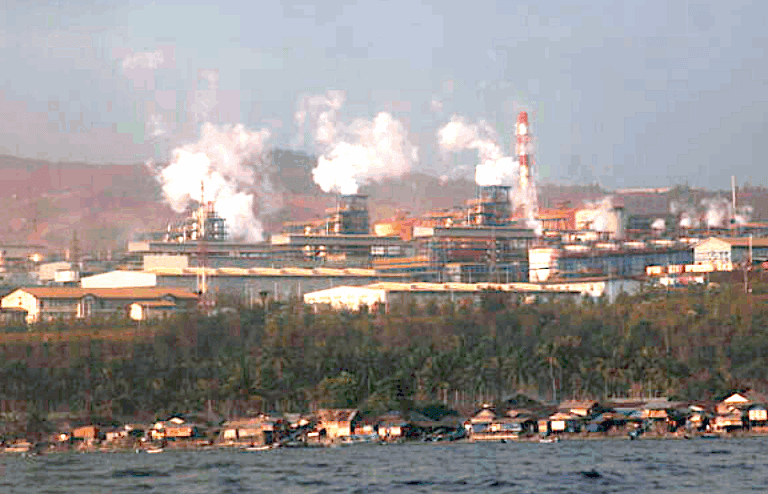
Image: Nickel industrial zone on Obi Island. Plumes of smoke from the coal-fired power plant rise into the air. © Rifki Anwar/ Mongabay Indonesia
Harita Group is one of Indonesia’s major nickel producers. The company operates an extensive value chain on Obi Island, from upstream to downstream activities, and remains heavily reliant on captive coal power plants for its nickel operations. As of 2025, Harita’s total emissions reached 16.10 MtCO2e, equivalent to the emissions from 3.8 million gasoline-powered passenger vehicles driven for one year. Harita’s energy needs are met by 910 MW of operating captive coal capacity, out of a total installed capacity of 1,670 MW, with the remaining capacity still under construction.
Despite the banks’ public coal commitments, DBS, OCBC and UOB participated in several major financing transactions for Harita Nickel and its subsidiaries since 2018, totalling US$923 million.
Harita’s coal powered nickel operations are not the only ones being funded by Singapore’s banks. Singaporean banks participated in financing linked to other industrial captive coal powered smelter projects between 2020 and 2025 according to Earthwise Institute, including:
- Tsingshan ’s250 MW Indonesia Morowali Power plant;
- ANTAM’s 300 MW FHT Industrial Park Power Plant.
- MIND ID’s 950 MW Kuala Tanjung captive power station and 75 MW Mempawah SGAR power plant;
Together, these transactions show that banks with coal-financing restrictions continued providing substantial finance to coal power plants via industrial companies.
Captive coal financing creates financial and reputational risks
The loopholes in the banks’ coal policies are escalating interconnected risks associated with coal financing. Carbon-intensive industries face growing pressure from carbon pricing, tighter emissions standards, technological change and demand for lower-emissions products. These shifts can increase costs and weaken the competitiveness of companies reliant on captive coal.
Physical climate risks add further layers of risk. Flooding can damage borrowers’ assets and increase credit risks for banks, with SGFIN estimating significant flood-related losses across Indonesian corporate loan portfolios by 2060.
The recent Southeast Asian YouGov and Market Forces survey on public attitudes to coal conducted across Singapore, Malaysia and Indonesia shows that consumers think banks ought to end finance for all coal power projects, including those powering nickel and aluminium smelters. A majority of people in Singapore (69%), Indonesia (66%), and Malaysia (59%) expect a bank’s commitment not to finance new coal projects to apply to all coal plants, including industrial captive ones.
In May 2025, JATAM brought letters and testimony from Obi Island residents directly to the Singaporean banks, raising concerns about the social and environmental impacts of Harita’s operations. In October 2025, other civil-society groups and church representatives also approached the banks to call for an end to financing Harita’s coal-powered nickel operations. In February 2026, Market Forces filed a complaint to the Singapore Exchange (SGX) alleging gaps in OCBC’s disclosure of captive coal exposure. The complaint brought further public and media scrutiny to whether the bank’s financing practices align with its coal commitments.
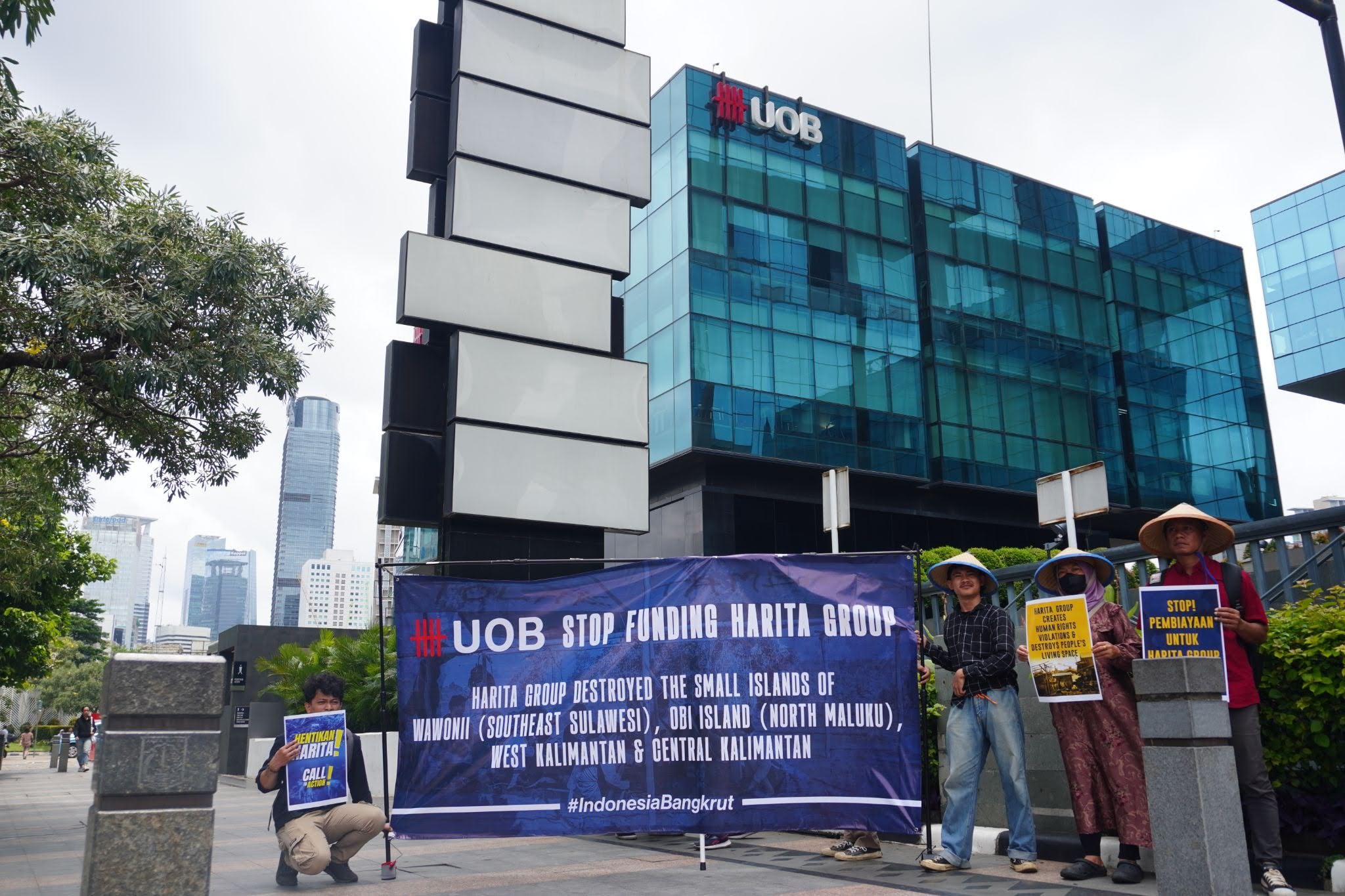
Image: Activists and Obi Island residents visited UOB’s office to deliver an open letter from the villagers concerning the environmental and social risks of Harita’s operations. © JATAM
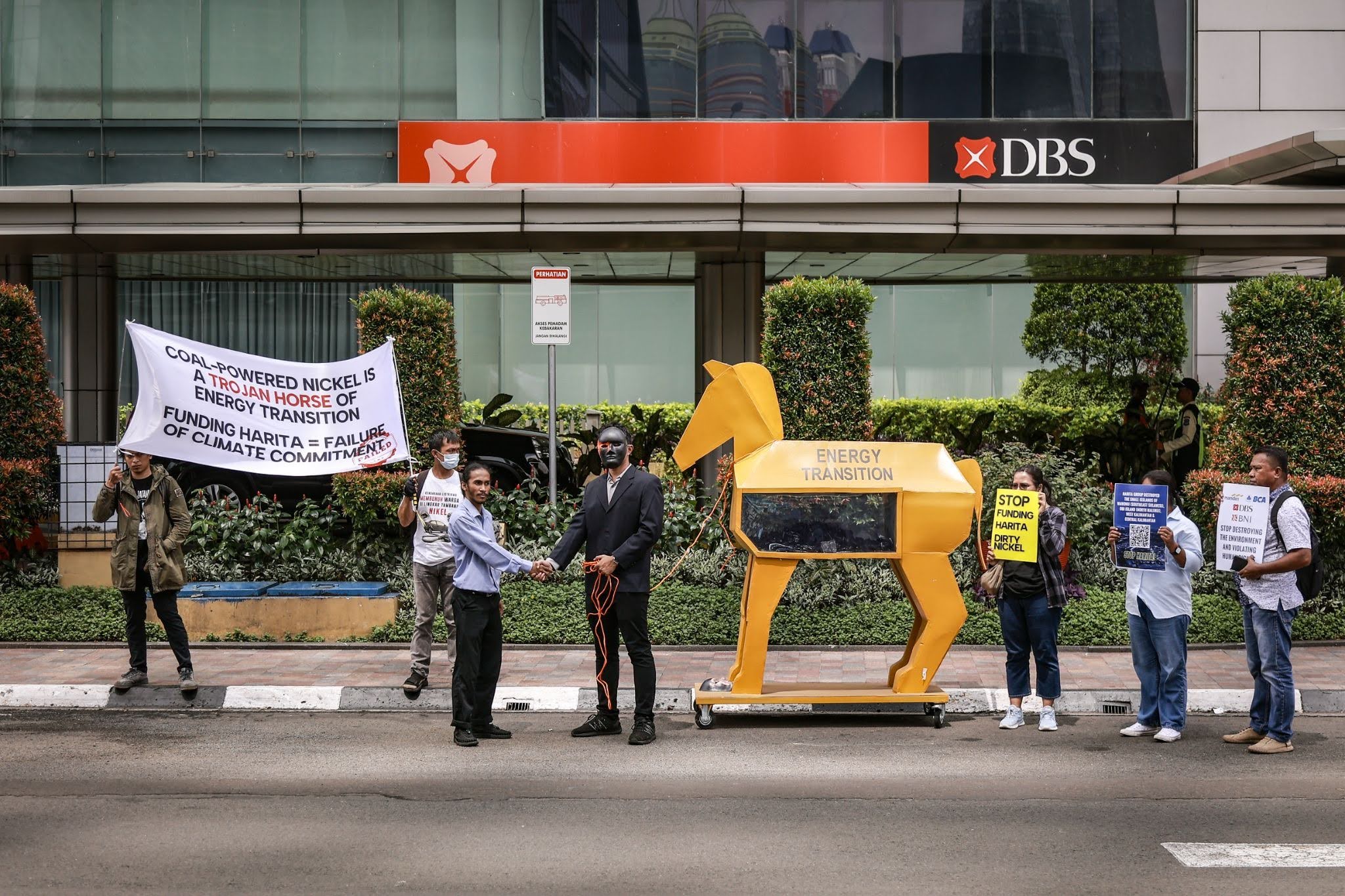
Image: Activists and Obi Island residents visited UOB’s office to deliver an open letter from the villagers concerning the environmental and social risks of Harita’s operations. © JATAM
Unless coal-financing policies cover captive power across all corporate sectors, banks remain exposed to a major source of new coal expansion, undermining the credibility of their responsible and sustainable financing commitments. This loophole creates not only a policy credibility gap, but also growing credit, physical, and reputational risks for the banks themselves.
Join us
Subscribe for email updates: be part of the movement taking action to protect our climate.